
Mali: Trajectory of a Multidimensional Crisis and the Quest for Sovereignty
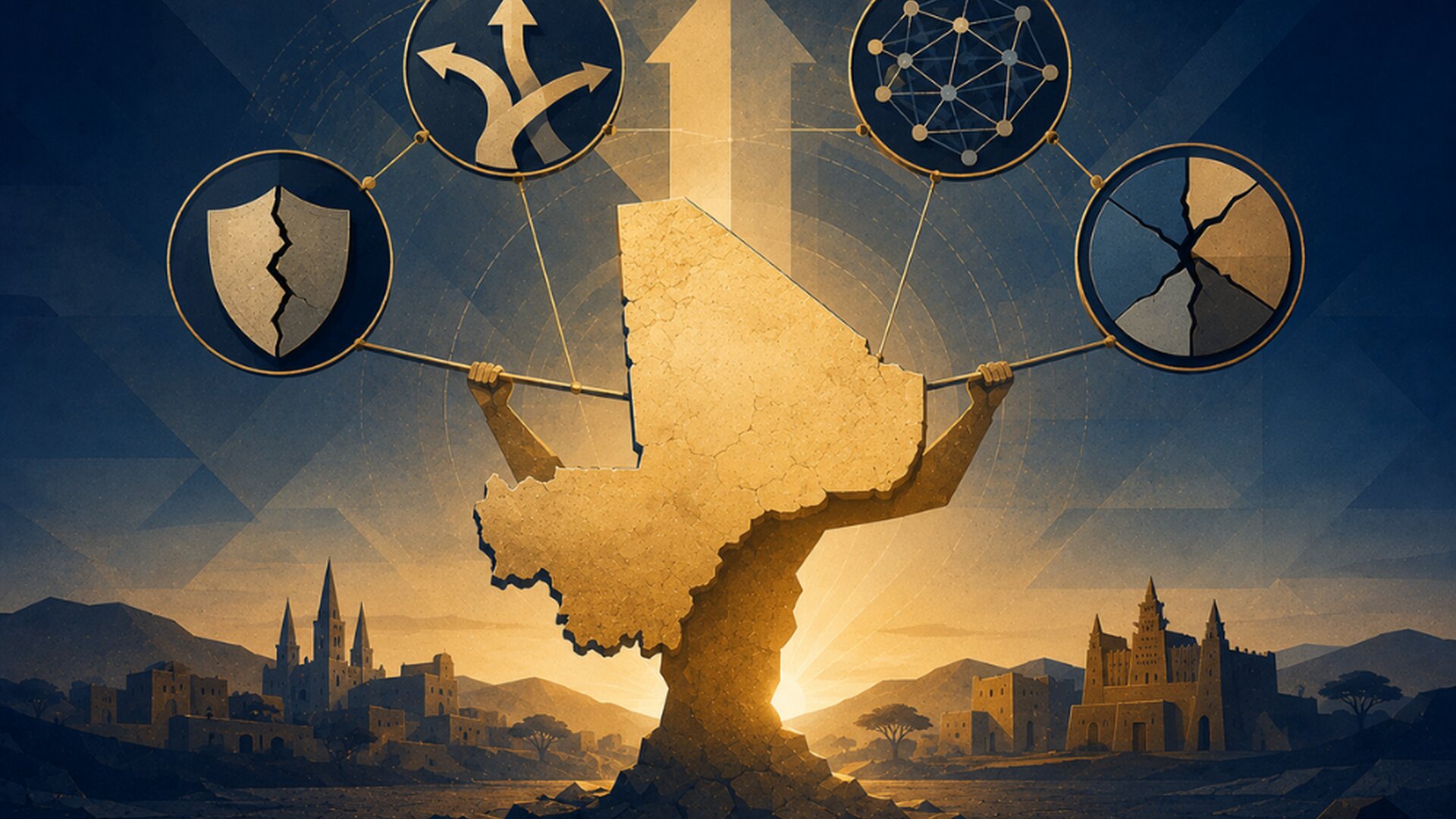
Mali, a country heir to great African empires, is today confronted with numerous multidimensional crises. It is among the rare countries in the world simultaneously facing four distinct and interconnected forms of armed violence and terrorism : jihadist terrorism, separatist armed groups, intercommunal violence, and organized criminal activities.
It is essential to distinguish between armed rebel groups pursuing independence and Salafist terrorist organizations operating in Mali, whose objective is to impose Sharia law and establish an Islamic caliphate through violence.
Contrarily to what many believe, the war in Mali did not simply begin in 2012. Rather, 2012 marks a significant turning point in a much longer conflict. This escalation was largely driven by a deterioration of the regional security environment particularly following the fall of Libyan leader Muammar Gaddafi. Tuareg rebellions in the country are not a recent phenomenon either. They date back several decades, with major uprisings occurring as early as 1963, then in 1990, 2006, and other periods.
Since the 2020 political transition, Mali has undertaken to reaffirm its sovereignty. However, despite efforts to strengthen its security capabilities, the country in 2026 still faces persistent insecurity, leading to shortages in fuel and electricity that affect the daily lives of its population. This paper argues that Mali’s sovereignty is undermined by a complex, long-standing crisis involving various armed actors, whose actions are closely connected.
Understanding the Armed Actors in the Malian Conflict
As mentioned earlier, this analysis distinguishes between armed terrorist groups, considered by international actors to be the primary security threat, and Tuareg separatist rebel groups, often viewed primarily from a political and territorial perspective. However, this distinction is becoming increasingly blurred, as some armed groups have interacted or formed tactical alliances during certain phases of the conflict, particularly around the events of 2012 and the subsequent attacks. Consequently, the Malian government tends to favor a less distinct approach between the two entities.
The Tuaregs belong to the Amazigh (Berber) ethno-linguistic group, found across Mali, Niger, Algeria, Burkina Faso, and Libya. The origin of their repeated rebellions lies in a desire for political and territorial independence, particularly in northern Mali along the borders with Algeria and Niger.
Historically, Tuareg groups in Mali have called for greater autonomy, or even full independence, citing governance that they describe as distant and unequal. This has fostered a sense of neglect in the northern regions, in a country where almost everything is concentrated in the south.
Furthermore, the Tuaregs have traditionally been part of vast trans-Saharan networks, maintaining social, commercial, and cultural ties across the Sahara, particularly with Arab communities in northern Mali and neighboring countries. These dynamics help explain why demands for autonomy have emerged periodically and evolved over time.
Although the Malian government has made efforts to address persistent concerns in the northern regions through decentralization, development programs, and attempts to improve representation in government bodies, these measures have only had a limited impact on the reduction of tensions.
Some analysts also believe that the conflict should not be viewed solely through the lens of internal factors and suggest that broader external interests may contribute to instability in the Sahel, particularly in a region known for its significant natural resources, such as the Taoudenit Basin (Taoudenit being an important region in northern Mali).
Indeed, according to the United States Geological Survey (USGS), the Taoudenit Basin is estimated to hold approximately 160 million barrels of oil that have not yet been explored, and nearly 1.88 trillion cubic feet of natural gas, highlighting its significant though as yet unproven potential for hydrocarbons.
Finally, it is important to note that Tuareg communities are not always the majority in northern Mali, where several other ethnic groups are also present in greater numbers. The northern regions of Mali are ethnically mixed, with groups such as the Songhai often forming the largest local communities, while Tuareg populations are present but not numerically dominant across the entire region.
From this perspective, the legitimacy and motivations behind separatist claims remain contested, and should be understood within a broader and complex political and security context rather than through a single explanatory narrative.
The first independentist armed group to be created was the MNLA (National Movement for the Liberation of Azawad), composed of Tuareg soldiers who had served in Gaddafi’s Libyan army. Its objective is the creation of an independent state in northern Mali, called Azawad, covering three major administrative regions: Timbuktu, Gao, and Kidal. The MNLA was formed through the merger of the National Movement of Azawad (MNA) and the Tuareg Alliance Niger-Mali (ATNM).
In January 2013, the Islamic Movement of Azawad (MIA) was created by former members of the terrorist group Ansar Dine. The MIA distinguished itself from terrorists, notably by opposing violent actions, and aligned itself with the MNLA. On May 19 the same year, the movement was dissolved and joined the High Council for the Unity of Azawad (HCUA), founded by Mohamed Ag Intalla.
The HCUA later allied with several other rebel groups within the Coordination of Azawad Movements (CMA) in 2014, and then within the Permanent Strategic Framework (CSP) in 2021. In 2024, the HCUA merged with other CSP groups to form the Azawad Liberation Front (FLA).
Regarding terrorist armed groups, several have been active during the Mali war, including Ansar Dine, AQIM (Al-Qaeda in the Islamic Maghreb), and MUJAO (Movement for Unity and Jihad in West Africa). The total number of terrorists is estimated at 6,500 fighters by the African Union, with the objective of establishing an Islamic state governed by Sharia law in Mali.
Summoning the Past to Understand the Present
In the early 2000s, Algerian jihadists sought clandestine refuge in Mali following their defeat in the Algerian civil war. In 2011, in the months following the Libyan civil war, Tuareg soldiers who had served in Gaddafi’s army returned to Mali, bringing with them Libyan military arsenals. Some joined the Malian Republican Army, while others contributed to the formation of the separatist MNLA movement.
In 2012, Tuareg rebels from the MNLA and Ansar Dine launched their fifth rebellion against the Malian state. They were later joined by terrorist groups Al-Qaeda in the Islamic Maghreb (AQIM) and the Movement for Unity and Jihad in West Africa (MUJAO), and succeeded in taking key northern towns, including Aguelhok, Menaka, and Tessalit.
Stunned by these heavy military defeats, a faction of the Malian army decided to overthrow President Amadou Toumani Touré. This March 2012 coup triggered clashes between the “green berets” (the putschists) and the “red berets” (the presidential guard). These internal confrontations disrupted operations in the North, allowing armed groups to seize Kidal, Timbuktu, and Gao.
However, ideological differences between independence-seeking rebels and Salafist terrorists quickly fractured their alliances. Between June and November 2012, battles turned against the MNLA, which was subsequently expelled from Gao, Timbuktu, Kidal, and Menaka. Terrorist groups then gained control over nearly the entire northern region of Mali.
After failed negotiation attempts, the terrorists launched an offensive on Ségou and Mopti in central Mali, the last line before reaching the capital. This prompted the intervention of France, which launched Operation Serval, alongside several West African countries under ECOWAS’ MISMA mission, later replaced by the UN Multidimensional Integrated Stabilization Mission in Mali (MINUSMA).
Within days, the terrorists were pushed back to Konna and Diabaly, and eventually expelled from Gao and Timbuktu. Abandoned towns were then reclaimed by the MNLA, notably Kidal.
On June 18, 2013, after two weeks of negotiations, the Malian transitional government and rebel groups signed a ceasefire agreement, allowing Malian authorities to return to Kidal and enabling the presidential election on July 28, 2013, which was won by Ibrahim Boubacar Keïta.
In May 2014, the controversial and hasty visit of then Malian Prime Minister Moussa Mara to Kidal triggered violent clashes between the Malian army and rebel groups, leading to an immediate security deterioration and the loss of state control over Kidal.
After several months of fighting, a peace agreement, the “Algiers Accord”, was signed on May 15 and June 20, 2015. However, jihadists continued their attacks, the peace agreements were repeatedly violated, and ethnically fueled violence escalated across the region.
The security situation in Mali is also influenced by its relations with neighboring countries. While cooperation with Senegal and Guinea remains relatively stable, growing tensions with Algeria, Côte d’Ivoire, and Mauritania have made regional security coordination more difficult in recent years. Bamako accuses these countries of providing safe havens for armed groups operating near their borders, while tensions with Algeria have further intensified following the incident involving the destruction of a Malian drone in Tinzaouatène in 2025.
Military Transition and the Redefinition of Mali’s Security Trajectory
Things took a significant turn following the military coup led by Assimi Goïta, then still a Colonel, which ended the presidency of Ibrahim Boubacar Keïta in August 2020. Under the new transitional military government, profound reforms were implemented. Mali’s traditional partner, France, was asked to withdraw all its troops from Malian soil immediately. Alongside them, all other Western foreign troops, as well as UN peacekeepers from the MINUSMA, also left the country.
Mali subsequently diversified its strategic partnerships, notably with Russia, Turkey, China, and others. This new political and strategic orientation, under the leadership of Army General Assimi Goïta, allowed the country to reaffirm its national sovereignty.
A large-scale mission to reconquer the integrity of the national territory was launched. Terrorist groups were expelled from several regions they still controlled. The recapture of Kidal by the Malian Armed Forces (FAMa) announced on November 14, 2023, marked a major turning point. After 11 years of control by armed terrorist groups, this recapture was significant, as Kidal had been considered an impregnable stronghold and the cradle of Tuareg rebellions since 2012. Its recapture represents a strong symbolic success for the transition.
At the regional level, with the recent creation of the Confederation of Sahel States (AES), Mali, along with Burkina Faso and Niger, strengthened its strategic alliances and reaffirmed its role as a security pivot in the region. Furthermore, according to the 2026 Global Firepower ranking, the Malian army is now the leading military force in the UEMOA and the second in West Africa after Nigeria, a strong indicator of its capacity to defend its territory and contribute to regional stability.
Between Security Pressures and National Resilience
Today, the situation in Mali remains marked by significant security and socio-economic tensions. While the state has regained substantive territorial control and restored its authority over strategic areas, terrorist armed groups have adapted their methods, now favoring targeted attacks and acts of sabotage aimed at infrastructure and public morale.
This intensification of the security threat has direct repercussions on daily life, notably through disruptions in fuel and electricity supplies. These challenges, though real, occur within a context of deep political and institutional transition, in which the Malian state is striving to rebuild capacities that were long weakened.
In the face of these challenges, the resilience of institutions and the population remains a central ally. Despite multiple pressures, the administration continues to function, the defense forces continue to strengthen their capacity, and the country follows a trajectory of progressive reaffirmation of its sovereignty. The current situation thus illustrates that the reconquest of strategic independence is a long, demanding, and costly process—but one that is fully undertaken.
About the Author
Souleymane Coulibaly is a master’s student in Management with a strong interest in governance, democracy, and development issues in Africa. He contributes to research at the Centre for Democracy and Development (CDD-West Africa), where his work supports analysis on governance and democratic development across the continent.