
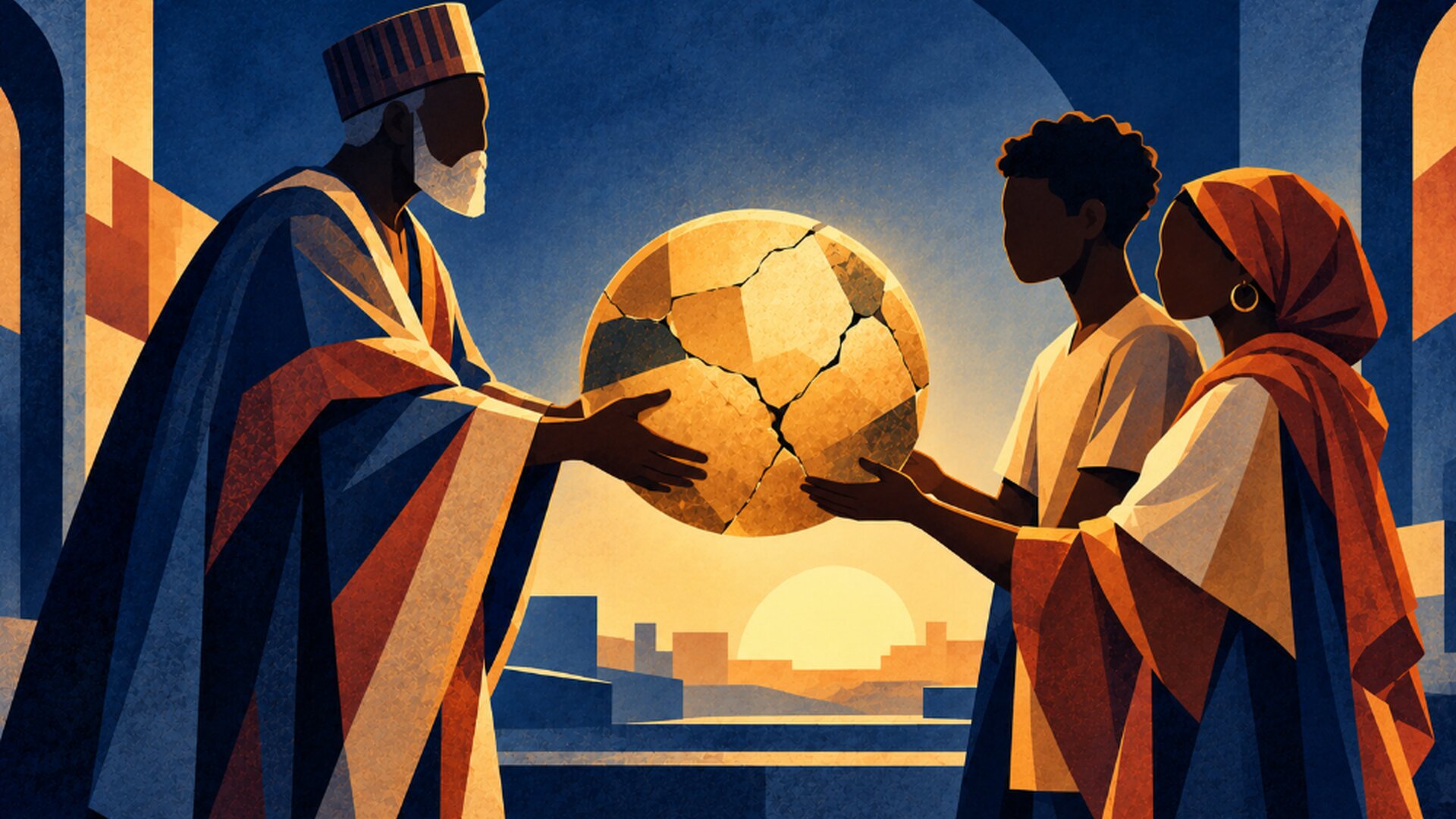
The 2027 Generational Reckoning and Nigeria’s Democratic Bargain
On 16 January 2027, Nigerians are scheduled to elect a president and members of the National Assembly. Governorship and state assembly elections follow on 6 February. But the election’s significance extends beyond who wins what political office. It will also test what democracy means to citizens who inherited civilian government and expect it to improve their lives.
The Nigeria that voted in 1999 is not the Nigeria that will vote in 2027. For many who had lived through military rule, the return to civilian government represented political restoration. Democracy was experienced as a dramatic contrast to authoritarianism. That historical reference point is no longer shared by the whole electorate. In figures announced on 6 October, the Independent National Electoral Commission (INEC) put the provisional register at about 103.4 million voters. Voters aged 35–49 constitute the largest group, at 41.83 per cent, while those aged 18–34 account for 28.79 per cent. New registrations remained subject to biometric verification, with the final register expected in December. These are registration figures, not turnout or voting intentions.
For those who experienced military rule, one question is: What happens when democracy disappears? For those who inherited civilian government, another is: What difference has democracy made? When freedom is inherited rather than recovered, freedom becomes the starting point of political expectation. This distinction helps explain the demands facing democratic institutions without assuming that age determines political beliefs.
From Democratic Euphoria to Democratic Expectation
Democracy is experienced through the quality of public institutions, the protection of rights, access to opportunity and the ability of citizens to influence the conditions under which they live. Afrobarometer’s nationally representative survey of 1,600 Nigerian adults in June–July 2024 found that 64 per cent preferred democracy to any other form of government, but only about 16 per cent were satisfied with its functioning. These national figures illustrate the gap between democratic preference and experience, though they are not youth-specific estimates.
A young Nigerian asking why they can vote but still struggle to find work is not necessarily rejecting democratic values. Afrobarometer’s analysis of the same survey found that the cost of living and unemployment topped the concerns of respondents aged 18–35. The report also found that 91 per cent of young respondents thought the country was heading in the wrong direction, compared with 95–98 per cent among older groups. Dissatisfaction is therefore not confined to those without adult memories of military rule. Their questions are about whether democracy is working. That distinction is critical for 2027.
What a Generation Has Been Asking
In 2012, #OccupyNigeria brought citizens into the streets following the removal of the petrol subsidy. It reflected demands for economic accountability as well as opposition to a particular policy. The #NotTooYoungToRun campaign framed the question differently. Young Nigerians challenged age barriers that restricted their access to elected office. The outcome of this was the constitutional amendment signed in 2018, which reduced the minimum age for presidential candidates from 40 to 35 and for House of Representatives and state assembly candidates from 30 to 25. The message was not that democracy was irrelevant. It was: democracy should make room for us.
Then came #EndSARS in 2020. What began as opposition to police brutality and the Special Anti-Robbery Squad became a broader demand for accountability and institutional reform. In August 2024, #EndBadGovernance protests centred on economic hardship and wider concerns about governance.
These movements should not be treated as one continuous campaign. They emerged from different circumstances and involved different actors. Together, however, they challenge the assumption that dissatisfaction necessarily means political indifference. They also demonstrated the ability of young Nigerians to mobilise outside conventional party structures and to use digital platforms to document abuses and coordinate collective action.
Participation and Democratic Credibility
Digitally connected Nigerians can compare public services, policing and elections elsewhere with their own experience. The comparison may not always be institutionally fair, but it can widen expectations of what the government should deliver. Online mobilisation, however, cannot stand for the priorities or participation of every young citizen.
Conditional disengagement can help explain some withdrawal. A politically apathetic citizen is largely indifferent to political affairs. A conditionally disengaged citizen may be highly interested in politics, informed about public affairs and capable of mobilisation, but withdraw from particular democratic channels when those channels are perceived as ineffective. A citizen can therefore be politically engaged but electorally disengaged.
Practical barriers matter too. The European Union’s 2023 election observation mission documented operational failures and intimidation that undermined participation. Low turnout cannot therefore be attributed to disillusionment alone. The challenge is not merely to persuade citizens to vote. It is to make participation safe, accessible and credible, and give citizens reason to believe it matters.
Japa and the Question of Belonging
The question of participation also extends beyond the ballot box. In the 2024 Afrobarometer survey, 60 per cent of Nigerians aged 18–35 said they had considered emigrating, primarily for better work opportunities or to escape economic hardship. Considering departure is not the same as leaving, and migration is not inherently a rejection of democracy. Yet the question becomes larger than whether young Nigerians will vote. Will they continue to invest their futures in Nigeria? Citizens who move abroad can remain politically engaged. The concern is whether staying feels like a viable choice.
The question of future investment leads inevitably to another question: What does it mean to be Nigerian? Outside Nigeria, national identity can sometimes become remarkably clear. The passport provides a legal identity. National symbols provide another. Nigerians abroad can find themselves sharing a sense of national identity that transcends differences of ethnicity, religion and region. Within Nigeria, however, citizenship can become more complicated.
The National Youth Service Corps was established in part to promote national integration and expose young Nigerians to communities beyond their states of origin. Yet the Federal Character Commission’s rules distribute public posts through state indigeneity. They define local indigeneity through a parent or grandparent, or acceptance by the local government. Residence alone is not the stated test. The tension is between encouraging mobility and making origin consequential for access to opportunity.
The issue is not that Nigerians have multiple identities. The issue is whether citizenship is strong enough to accommodate those identities within a shared conception of belonging. A Nigerian citizen should not become politically less Nigerian because they move from the place of their ancestry.
The 2027 Democratic Bargain
The 2027 electorate is therefore not a homogeneous one. It is a generationally layered electorate, in which the meaning of democracy is itself changing. The democratic dividend cannot remain an abstract promise. For citizens, democracy is experienced through the security of a community, the quality of a school, the accessibility of a hospital, the reliability of electricity, the fairness of an institution, the possibility of employment, the ability to start a business, the protection of rights and the confidence that public authority will be exercised according to rules. The test of democracy is therefore not simply whether elections take place. It is whether democratic institutions can convert political authority into public value. That is the social contract the 2027 election will test.
The implications are significant.
First, government must demonstrate that public institutions can become responsive enough for citizens to regard the state as a meaningful partner in their everyday lives rather than an institution they must routinely bypass.
Second, democratic citizenship must become more inclusive. A Nigerian’s ability to participate fully in national life should not depend excessively on ancestral origin, place of birth or inherited classifications of indigeneity and settlement.
Third, democracy must produce tangible opportunities. Security, employment, education, healthcare, infrastructure, reliable electricity, entrepreneurship and economic dignity are not separate from democratic legitimacy. They are among the ways citizens experience the democratic bargain.
These are not demands for perfection. They are demands for evidence that democracy can improve the conditions under which citizens live. If the generational character of the electorate is changing, the democratic conversation must change with it. Young Nigerians do not need to be told that they should be grateful for democracy. They need reasons to believe in it. The generation that fought for democracy must also help build a democracy that the next generation considers worth defending. Hence, the most important question surrounding Nigeria’s 2027 election may therefore not be who occupies the presidency, which party controls the National Assembly or which candidates win state elections. Those are important questions. But beneath them lies a deeper one: Can Nigeria’s democracy persuade the generation that inherited it that democracy is worth preserving, participating in and investing in?
The answer will depend on more than the conduct of Election Day. It will depend on whether democracy can deliver security without sacrificing rights; participation without exclusion; institutions without impunity; citizenship without indigeneity determining one’s worth; and economic opportunity without forcing citizens to look elsewhere for a future.