
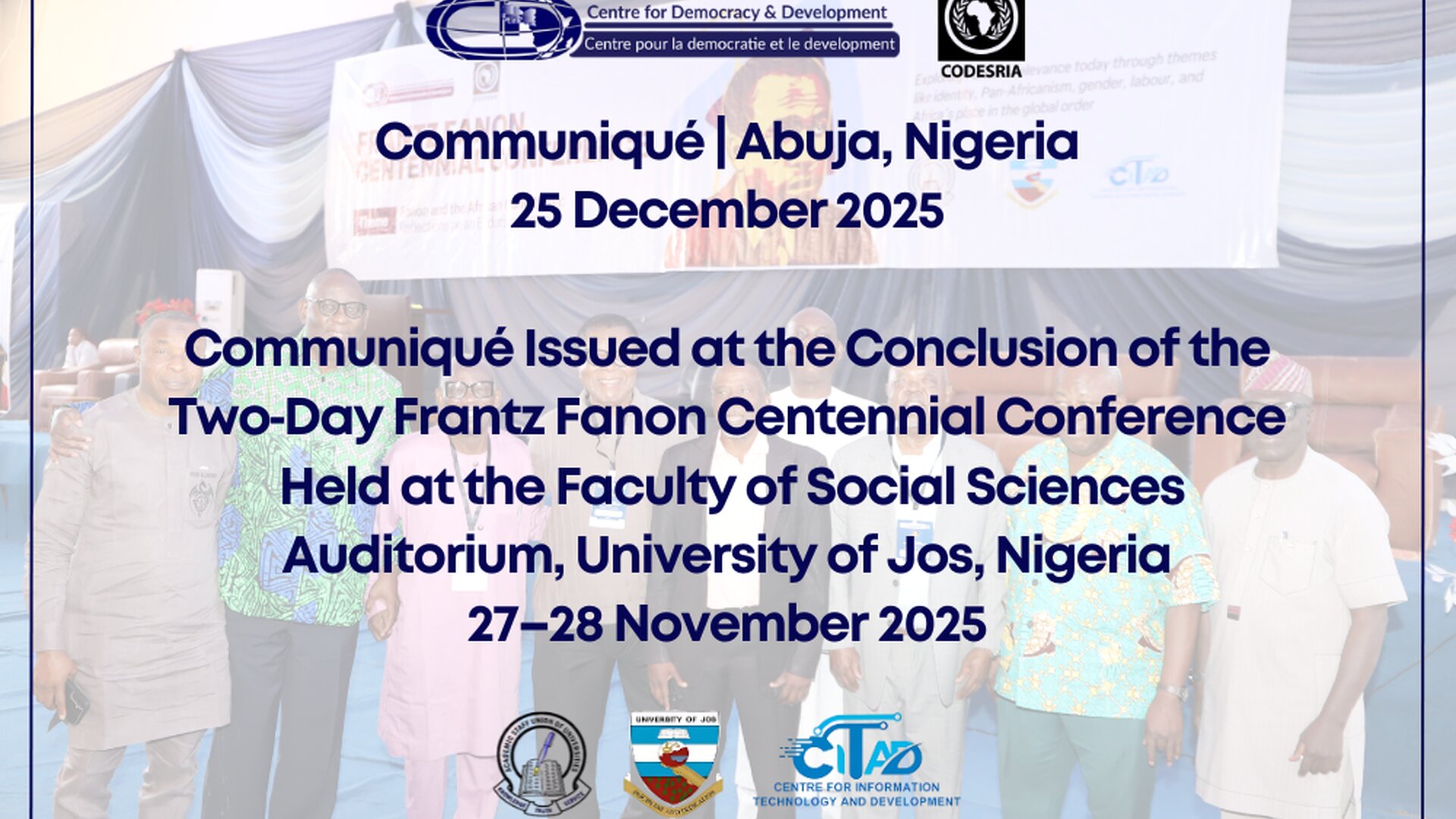
Communiqué Issued at the Conclusion of the Two‑Day Frantz Fanon Centennial Conference Held at the Faculty of Social Sciences Auditorium, University of Jos, Nigeria 27–28 November 2025
Preamble
Scholars, policymakers, students, civil society actors, artists, women and gender activists, trade unionists, and representatives of regional and continental bodies convened at the Frantz Fanon Centennial Conference held at the University of Jos, Nigeria to reflect on the enduring relevance of Frantz Fanon’s thought on Africa’s political, economic, and social realities. The conference was attended in-person by 638 (Six Hundred and Thirty-Eight) persons on Day-1 and 412 (Four Hundred Twelve) persons on Day-2. Online participation figures were 242 participants for Day-1 and 167 participants for Day-2.
Held under the theme ‘Fanon and Africa’s Condition: Reflections on an Enduring Legacy’, with a Keynote delivered by Professor L. Adele Jinadu under the Chair of Professor Georges Nzongola-Ntalaja and inter-generational dialogue facilitated by Professor Okwudiba Nnoli, the conference recognises Fanon not merely as a revolutionary thinker, psychiatrist, and anti-colonial activist, but as a prophetic voice whose ideas illuminate the persistent contradictions of post-colonial governance.
Observations
Participants affirm that sixty years after Fanon’s passing, many African states still confront unresolved structural challenges: neo-colonial economic dependencies, elite domination, violent governance cultures, increasing women and youth marginalisation and disillusionment, and widening legitimacy deficits. The conference emphasises that engaging Fanon today requires not just commemoration but action towards justice, dignity, autonomy, and people-centred governance.
Participants observed that Africa is experiencing democratic decline and democratic backsliding, essentially due to the persistence of neo-colonial structures, thinking, and institutions. This, they affirm, was long theorized by Fanon that the national petty bourgeoisie in Africa is incapable of liberating both itself and the countries it inherited from colonialism through colonial and nationalist struggles.
Resolutions and Commitments
conference thus resolves and recommends the following:
- Political Governance and Democratic Renewal
Participants identify the urgent need to:
- Strengthen people's organizations through research, advocacy, and solidarity that are rooted in the struggle against neocolonialism and neoliberalism to establish genuinely free countries in the African continent;
- Deepen protections for civic space, free expression, academic freedom, and press independence across all African states; and
- Demand that the African Union (AU) and Regional Economic Communities (RECs) adopt minimum continental standards on political party financing, electoral integrity, and accountable governance.
- Economic Transformation and Structural Change
Participants at the conference:
- Reaffirm Fanon’s critique of extractive economies and commit to advocating for value addition, industrialisation, and regional production networks rather than continued dependence on raw commodity exports;
- Call on African people to demand and make the Africa Union (AU), African Continental Free Trade Area (AfCFTA) Secretariat, and national governments to support a Continental Industrialisation and Value-Addition Framework, driven by technology, green economy innovation, and youth-led entrepreneurship; and
- Urge national governments to pursue economic sovereignty, fair taxation, and stronger protection of natural resources, including critical minerals to the global energy transition.
- Youth mentorship, Fanonist Clubs and Transformative Activism Participants at the conference agree to:
- Acknowledge the dissatisfaction, disaffection, and the energy of youth and their creative utilization of technology to effect a change, and to continue to study, understand, and support them by providing them with solidarity and access to knowledge
- Set up a mentoring structure between elder and young scholars in the process of anti colonial knowledge production and its utilization in promoting the transformation of the African continent;
- Facilitate the establishment of Fanonist clubs in institutions of higher learning in Nigeria and in other African countries for socializing young people into Fanonist ideas,
laying the foundation for mental emancipation, and producing critical minds among them; and
- Advocate partner organizations to commit themselves, individually and collectively, to establishing both a mentoring framework for knowledge production and the transformation of Africa and its countries.
- Youth Agency and Transformative Leadership
Participants at the conference:
- Identify with the centrality of the voices of young people to Africa’s liberation project and thus recommend the creation of a Pan-African Youth Civic Corps to strengthen civic engagement, local governance, and leadership cultivation; and
- Advocate that universities, political parties, and civil society organisations be encouraged to establish pathways for youth inclusion in policymaking, budgeting, and peacebuilding.
- Women and African Transformation
Conference participants:
- Identify with the goals of the global activism against Sexual and Gender-Based Violence (SGBV) and explores how Fanon’s ideas help in interrogating the structures that enable colonial violence, patriarchy, and economic subjugation;
- Commit to true liberation which must transform not only political systems, but also the intimate and social spaces where inequality is reproduced; and
- Commit to a shared project to build a world where nobody, especially on the basis of being a women, is treated as inferior, disposable, or violable.
- Peace, Security and Demilitarisation
Participants at the conference:
- Emphasise the urgent need for security sector reform (SSR), particularly demilitarised policing, community-based safety models, and accountability mechanisms; and
- Encourage RECs to coordinate efforts on cross-border security, mediation, and early-warning systems rooted in community participation.
- Decolonising Knowledge, Mental Health and Healing
Recognising Fanon’s psychiatric legacy, participants:
- Underscore the psychological dimensions of liberation, calling for mental health integration into public policy, especially in conflict-affected regions; b. Commit to supporting decolonised curricula, African intellectual traditions, and the expansion of research centres dedicated to African philosophy, languages, and political thoughts, and
- Urge governments and universities to fund community healing programmes, trauma recovery, and cultural renewal initiatives.
- Pan-African Solidarity and Global Justice
Conference participants:
- Stress the importance of Pan-African cooperation, including unified continental stances on debt, fair trade, taxation, migration, climate justice, and global governance reform;
- Endorse strengthening AfCFTA implementation, regional integration, and intra African mobility as pathways to Fanon’s vision of collective emancipation; and c. Reaffirm solidarity with African people’s resistance to oppression, authoritarianism, economic subjugation, and armed conflict.
Institutional Outcomes
The conference resolved to:
- Establish a Fanonian Futures Working Group (FFWG) to coordinate research, training, and policy advocacy across Africa.
- Publish an Annual Fanon Report assessing governance, democracy, structural transformation, and social justice trends on the continent.
- Support inter-university networks for Fanon Studies, decolonial scholarship, and cross-disciplinary analysis.
- Explore collaboration with the AU, RECs, UN agencies, and civil society organisations to operationalise key recommendations.
Appreciation
Participants express deep appreciation to the Governor of Plateau State, the Vice Chancellor of the University of Jos, Nigeria, CDD-West Africa, CODESRIA, ASUU, University of Jos, CITAD, National Institue of Policy and Strategic Studies (NIPSS), ITUC-Africa, NLC, TUC, academics from all over Africa, Europe and America, activists and volunteers for a successful conference. Students and community participants are alos appreciated for enriching the debates.
Finally, the Central Planning Committee as well as the Local Organising Committee are duly appreciated for putting together this conference.
Closing Statement
The conference concluded with a renewed commitment to transforming Fanon’s insights into concrete action. Delegates affirmed that Africa stands at a critical juncture: the future demands courage, imagination, and structural change. In the spirit of Fanon, the communiqué calls for the building of societies rooted in dignity, justice, equality, and the full humanity of all.
SIGNED:
Professor Pam Dung Sha
Chairperson, Conference Organising Committee
Dr. Dauda Garuba
Director, Centre for Democracy & Development (CDD-West Africa)
Comrade Yunusa Z. Ya’u
Secretary, Conference Organising Committee