
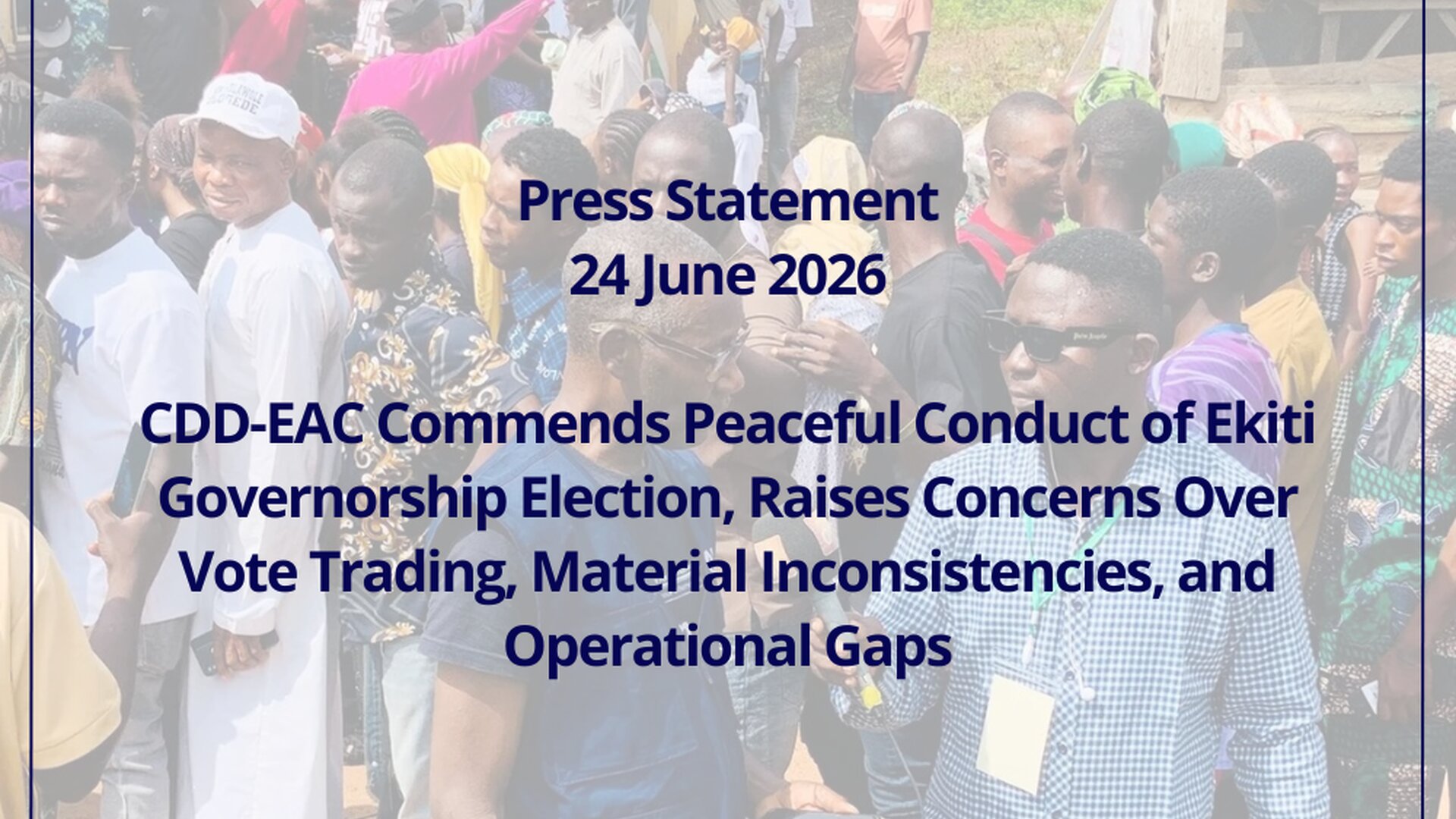
CDD-EAC Commends Peaceful Conduct of Ekiti Governorship Election, Raises Concerns Over Vote Trading, Material Inconsistencies, and Operational Gaps
Introduction
The Centre for Democracy and Development (CDD-West Africa), through its Election Analysis Centre (EAC), has commended the generally peaceful conduct of the 2026 Ekiti State Off-Cycle Governorship Election held on Saturday, 20 June 2026, while raising concerns over vote trading, inconsistencies in sensitive election materials, and operational gaps observed during the process.
CDD-EAC deployed accredited observers across the sixteen (16) Local Government Areas of Ekiti State to monitor the pre-election environment, election-day procedures, deployment of personnel and materials, voter accreditation and voting, security operations, counting and collation processes, information integrity, and the conduct of political parties and other stakeholders.
This press statement draws on reports submitted by accredited observers, information received through the Election Analysis Centre, stakeholder engagements, media monitoring, and verified information collected throughout the electoral process, including developments that emerged after Election Day.
Election Outcome
Following the completion of voting, counting, collation, and declaration of results, the Independent National Electoral Commission (INEC) declared the candidate of the All Progressives Congress (APC), Biodun Oyebanji, winner of the 2026 Ekiti State Governorship Election.
According to the official results announced by INEC, Oyebanji secured 319,224 votes, winning all sixteen Local Government Areas of the state and accounting for nearly 85 per cent of the total valid votes cast. The Peoples Democratic Party (PDP) candidate, Wole Oluyede, placed second with 40,543 votes, while the African Democratic Congress (ADC) candidate, Oluwadare Bejide, finished third with 12,872 votes. Collectively, the three leading candidates secured more than 99 per cent of all valid votes cast in the election.
Beyond the numerical outcome, the election represents an important milestone in Ekiti State’s democratic trajectory. The re-election of Governor Biodun Oyebanji marks the first time an incumbent governor has secured a consecutive second term in the state’s political history, signalling a departure from the pattern of electoral turnover that has characterised previous governorship elections in the state.
The scale of the victory recorded by the declared winner also reflects a highly asymmetrical electoral contest. While the outcome falls within democratic norms and reflects the official results declared by INEC, it raises important questions regarding the competitiveness of political party structures, opposition mobilisation capacity, and the broader state of electoral competition in Ekiti State. These issues merit deeper examination in subsequent post-election assessments.
CDD-EAC notes that post-election reactions revealed divergent perceptions of the electoral process among key political actors. While the declared winner accepted the outcome, opposition candidates and their supporters expressed reservations regarding the conduct of the election. The campaign organisation of the PDP candidate, Dr. Wole Oluyede, rejected the result announced by INEC, alleging that it did not reflect the true aspirations and democratic will of the people of Ekiti State and that the process was marred by widespread irregularities. Similarly, the ADC candidate, Oluwadare Bejide, rejected the outcome and publicly questioned the credibility of the process.
While CDD-EAC does not adjudicate electoral disputes and takes no position on the merits of such claims, it recognises the right of all candidates and political parties to seek redress through lawful and constitutionally established mechanisms.
Overall Assessment
CDD-EAC assesses that the election was conducted in a generally peaceful atmosphere and without widespread incidents of violence capable of substantially undermining the overall conduct of the process.
The election benefited from relatively early deployment of election officials and materials in many polling units, visible security presence across the state, and prompt interventions by INEC supervisory and technical support teams where operational challenges arose.
However, the election was also characterised by serious concerns relating to electoral integrity. These included widespread allegations and direct observations of vote buying and voter inducement, inconsistencies in sensitive election materials, isolated procedural violations, BVAS malfunctions in some polling units, and misconduct by some party agents.
CDD-EAC also notes that the election period witnessed the circulation of viral videos and allegations capable of influencing public perceptions of the electoral process. Through its fact-checking and information integrity initiatives, the Centre investigated and published findings on several claims, helping to clarify misleading narratives and reduce tensions within the electoral environment.
Key Findings
Election Administration and Logistics
Observers reported that election officials and materials arrived early in many polling units, allowing accreditation and voting to commence on schedule. INEC’s deployment of technical support and supervisory teams contributed to addressing operational challenges observed during the election.
Nevertheless, isolated delays in deployment were recorded in some locations. CDD-EAC also observed inconsistencies in sensitive election materials, particularly discrepancies between ballot papers and result sheets regarding the number of political parties reflected in official election documents. Such inconsistencies should be thoroughly reviewed and addressed by INEC.
Accreditation and Voting
Voting generally proceeded in an orderly manner across most polling units observed. However, several BVAS devices experienced operational failures that temporarily disrupted voter accreditation and voting.
Observers also documented isolated procedural violations, including instances of unstamped ballot papers and inappropriate interference by some party agents in electoral procedures.
Security Environment
The election was conducted in a largely peaceful and secure environment. Security personnel maintained a visible presence across the state and generally discharged their responsibilities professionally.
CDD-EAC observers did not report widespread incidents of voter intimidation, harassment, or election-related violence. The absence of military deployment also contributed to a relatively calm electoral atmosphere.
Positive Developments
CDD-EAC observed several positive developments that contributed to the overall conduct of the election. These included the generally timely deployment of election personnel and materials in many polling units, the responsiveness of INEC technical support teams to operational challenges, the professional conduct displayed by most election officials, and the peaceful behaviour of voters throughout the state.
The Centre also notes the relative effectiveness of inter-agency security coordination and the absence of widespread election-related violence, which contributed to a stable electoral environment. These improvements demonstrate the value of sustained institutional learning and should be consolidated in future electoral processes.
Voter Participation
Official figures released by INEC indicate that 382,010 votes were cast out of 1,059,360 registered voters, representing a voter turnout of approximately 36.07 per cent.
CDD-EAC notes that while many citizens demonstrated enthusiasm and commitment to the democratic process, turnout remained relatively low compared to the size of the registered voter population. Observations from polling units across the state similarly indicated lower-than-expected voter participation in several locations.
The turnout recorded in the election appears consistent with broader trends of declining electoral participation in off-cycle elections across Nigeria. While the election produced a decisive outcome, the relatively low level of participation raises important questions regarding voter confidence, political engagement, electoral competitiveness, and the effectiveness of voter mobilisation efforts.
The continued challenge of voter apathy underscores the need for sustained civic engagement, voter education, and measures aimed at strengthening public trust in electoral processes and democratic institutions.
Vote Buying and Electoral Inducement
CDD-EAC’s most significant concern arising from the election relates to the persistence of vote buying and voter inducement.
Observers documented multiple incidents across different Local Government Areas in which voters were allegedly offered or received financial inducements after casting their ballots. Reports received by the Centre indicated organised arrangements involving party agents, intermediaries, and designated payment locations situated near polling units.
The Centre notes that allegations of widespread vote buying also featured prominently in post-election reactions by opposition political parties and candidates. While CDD-EAC does not adjudicate political claims, observations made by its field teams lend credence to concerns that vote trading remained a significant feature of the electoral environment.
CDD-EAC is particularly concerned that the persistence and apparent normalisation of vote buying continue to undermine the principles of free choice, electoral fairness, and democratic accountability.
Emerging Concerns Requiring Investigation
CDD-EAC monitored several widely circulated videos and allegations during the election period that generated public concern regarding the integrity of the electoral process.
CDD-EAC also observed reports and videos alleging that personnel involved in monitoring election-day financial inducement and electoral offences were obstructed or prevented from carrying out their responsibilities in certain locations. Although these incidents were not directly observed by CDD-EAC and remain unverified by the mission, they are concerning given the critical role of anti-corruption agencies in deterring electoral malpractice.
The Centre therefore calls on INEC, security agencies, the Economic and Financial Crimes Commission (EFCC), and other relevant institutions to conduct prompt, impartial, and transparent investigations into credible allegations relating to voter inducement, voter eligibility violations, electoral misconduct, and interference with lawful monitoring activities.
Information Integrity
As part of its efforts to promote information integrity and reduce the risk of misinformation influencing public perceptions of the electoral process, CDD-EAC actively monitored, verified, and fact-checked a range of claims and narratives circulating before and during the election period.
Through its fact-checking team, the Centre investigated several viral claims, including a video alleging the distribution of Permanent Voter Cards (PVCs) by the All Progressives Congress (APC), reports of the alleged distribution of bread and other food items to residents for electoral purposes, and claims of political violence in Isan, Ekiti State.
Another video that was widely shared alleged the mobilisation of individuals described as non-indigenes to vote in the election by issuing voter cards to them.
Following detailed verification and evidence-based assessment, CDD-EAC published fact-check reports that debunked, clarified, or contextualised misleading and unverified claims where necessary. These interventions provided the public with accurate information, helped counter the spread of misinformation and disinformation, and contributed to reducing tension and speculation within the electoral environment.
The election brought to the fore the need for public figures and high-profile personalities to verify information before sharing, as some of the most viral claims related to the election were shared by individuals with significant social media presence.
The Centre’s fact-checking activities formed an important component of its broader strategy to support peaceful participation, informed public discourse, and electoral transparency throughout the election period.
Further Post-Election Assessment
While this statement outlines CDD-EAC’s principal observations and conclusions regarding the 2026 Ekiti State Governorship Election, it does not exhaust the full range of issues arising from the electoral process.
CDD-West Africa is undertaking a more extensive post-election assessment that will examine election administration, voter turnout patterns, electoral competitiveness, vote-buying dynamics, information integrity, security deployment, stakeholder behaviour, and broader implications for electoral reform. The resulting report will provide evidence-based recommendations to support improvements ahead of forthcoming off-cycle elections in Osun and the 2027 General Elections.
Recommendations
CDD-EAC calls on
INEC to:
- Investigate and publicly clarify inconsistencies observed in sensitive election materials.
- Strengthen quality assurance mechanisms for election materials prior to deployment.
- Improve BVAS functionality and contingency arrangements.
- Enhance accessibility of polling units for persons with disabilities and elderly voters.
- Intensify voter education and public communication efforts.
Security Agencies to:
- Sustain the professionalism demonstrated during the election.
- Strengthen enforcement efforts against vote buying and electoral offences.
- Investigate allegations of interference with lawful election-monitoring activities.
EFCC and Other Anti-Corruption Agencies to:
- Increase operational visibility during elections.
- Strengthen monitoring and prosecution of vote-buying networks.
- Publicly communicate actions taken against electoral offenders.
Political Parties to:
- Promote compliance with electoral laws and democratic norms.
- Sanction party agents implicated in electoral misconduct.
- Reject inducement-based mobilisation strategies.
- Strengthen internal voter engagement strategies based on policy issues rather than financial inducements.
- Improve the training and supervision of party agents to reduce procedural violations at polling units.
- Commit publicly to issue-based campaigns that enhance voter confidence and democratic participation.
Call to Action
CDD-EAC urges INEC, security agencies, anti-corruption institutions, political parties, civil society organisations, media practitioners, and other stakeholders to treat the lessons emerging from the Ekiti election as an opportunity for institutional improvement.
Particular attention should be paid to combating vote buying, strengthening voter participation, improving election technology performance, enhancing transparency, and addressing emerging threats associated with misinformation and disinformation.
Conclusion
CDD-EAC commends the people of Ekiti State for their peaceful participation in the 2026 Governorship Election and acknowledges the efforts of INEC, security agencies, civil society organisations, media practitioners, and other stakeholders who contributed to the conduct of the election.
While the election was generally peaceful and orderly, the persistence of vote buying, procedural lapses, inconsistencies in election materials, and allegations requiring further investigation demonstrate that significant challenges remain in Nigeria’s electoral process.
The Centre urges relevant institutions to investigate credible allegations arising from the election and to take concrete measures to address the recurring challenge of vote buying and electoral inducement. Doing so will be critical to strengthening public confidence in future elections, including the forthcoming Osun State Governorship Election and the 2027 General Elections.
CDD-EAC remains committed to promoting electoral integrity, democratic accountability, and credible elections in Nigeria.
SIGNED
Dauda Garuba, PhD. Professor Victor Adetula
Director, Chair,
CDD-West Africa Election Analysis Centre
For media enquiries, please contact Faridha Salihu-Lukman, Communications Officer (fslukman@cddwestafrica.org or 0810 625 9235). Press statements are also available at www.cddwestafrica.org/press-releases, and other reports cited and referenced are available at www.cddwestafrica.org. CDD-West Africa is available on social media platforms with the handle CDDWestAfrica.