
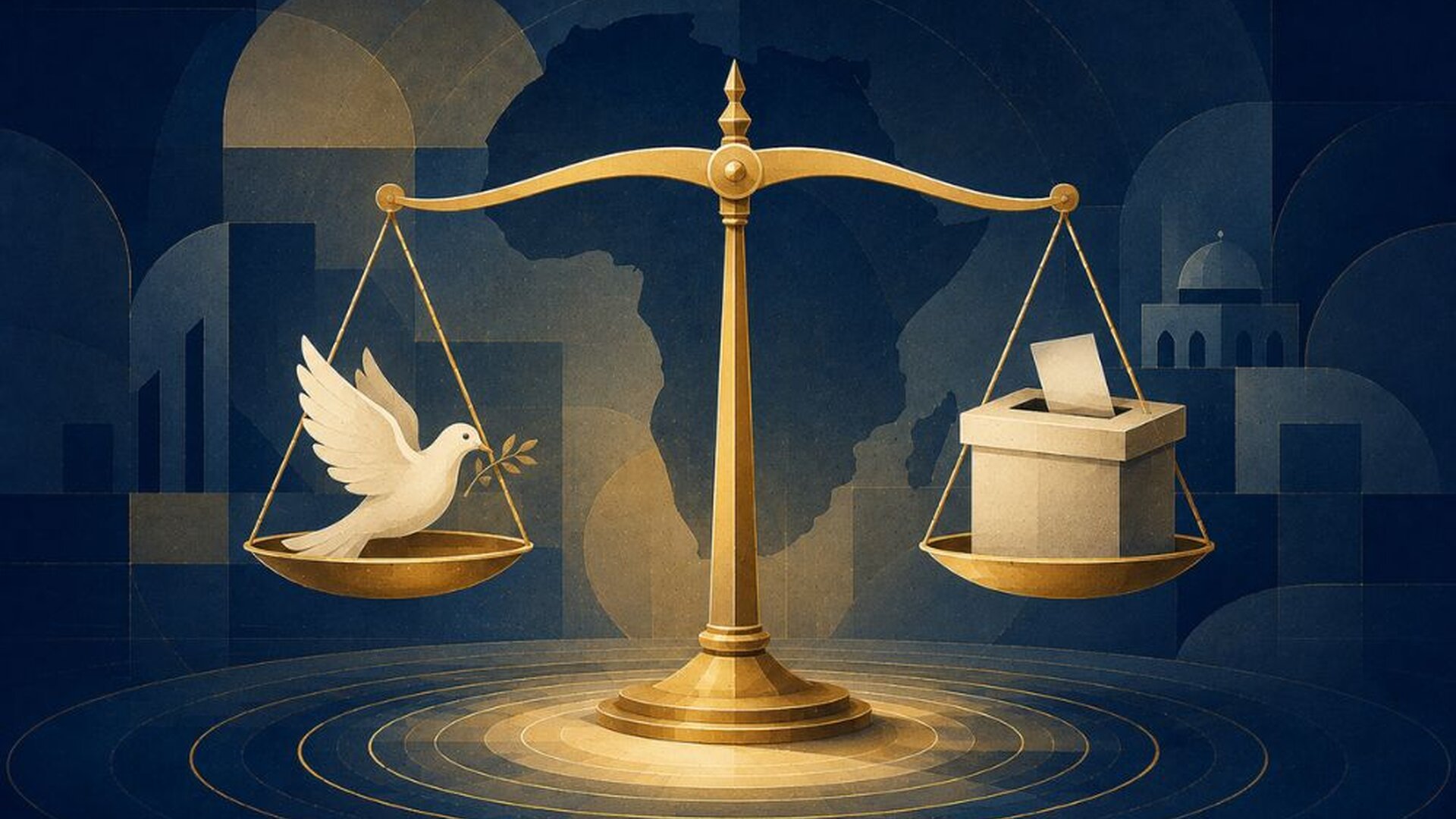
Peace at What Cost? Balancing Peace and Electoral Justice in African Electoral Transitions
Across Africa, electoral transitions are often celebrated as milestones of democratic progress. Yet beneath the ritual of voting lies a recurring dilemma that has become increasingly familiar in many democracies on the continent. A central message by continental, regional and international missions to most aggrieved parties, when the outcomes of such elections are disputed, or allegations of manipulation emerge, is to "give peace a chance and pursue their grievance via legal means" rather than mass mobilisation.
During the 2023 elections in Nigeria and Sierra Leone, allegations of electoral irregularities generated deep grievances among opposition parties, civil society actors, and particularly young people who believed that democratic processes had been compromised. However, in a statement issued on 3 March 2023, the Chairperson of the African Union Commission, H.E. Moussa Faki Mahamat, congratulated President-elect Bola Ahmed Tinubu and urged stakeholders to pursue their grievances through the courts while preserving peace and stability. Similarly, in Sierra Leone, the African Union and ECOWAS Election Observation Missions jointly congratulated Sierra Leoneans for the peaceful conduct of the elections while calling on stakeholders to remain calm and pursue constitutional avenues for addressing grievances. They also emphasised the need for transparency and accountability in the tabulation process.
During both the 2020 and 2025 electoral cycles in Cote d’Ivoire, political actors, opposition groups, and youth constituencies were repeatedly encouraged by ECOWAS, the African Union, the United Nations, and other international actors to exercise restraint and prioritise peace to avoid a relapse into violence. External partners were particularly concerned that unresolved grievances and growing political polarisation could trigger a relapse into conflict. These appeals were not without justification, as the devastating 2010–2011 post-election crisis in Cote d’Ivoire and the military takeovers in Mali, Guinea, Burkina Faso, and Niger have demonstrated how prolonged political crises and declining confidence in democratic institutions can create openings for unconstitutional changes of government. However, these experiences also reveal a recurring pattern: when elections are contested, peace is often prioritised over justice.
Yet an important question remains largely unexamined: what happens when peace is repeatedly prioritised over justice? It also raises uncomfortable questions about the role of regional organisations, election observation missions, and democracy-support actors in managing contested political transitions.
Peace at what cost?
There is no doubt that peace matters. The prevention of violence saves lives, protects institutions, safeguards economic activity, and creates opportunities for democratic engagement. For mediators, election observers, regional organisations, and peacebuilders, the logic is straightforward: the costs of instability are simply too high. In fragile democracies, even minor political disputes can escalate into broader crises. Calls for restraint, dialogue, and compromise are therefore often necessary tools for preventing violence and maintaining social cohesion. The challenge arises, however, when peace becomes the sole measure of democratic success.
A democracy cannot be judged merely by the absence of violence. Democratic governance also depends on accountability, legitimacy, citizen trust, and confidence that political competition is conducted fairly and transparently. The African Charter on Democracy, Elections and Governance and the ECOWAS Protocol on Democracy and Good Governance both emphasise constitutional governance, credible elections, and democratic accountability. To maintain public confidence, interventions aimed at preserving peace must also be seen to uphold these principles. Otherwise, the pursuit of stability may inadvertently weaken public trust in the institutions tasked with safeguarding democratic governance.
When allegations of electoral wrongdoing are left unresolved, citizens may begin to question whether democratic institutions can deliver justice. More concerningly, persistent perceptions of electoral injustice can erode public confidence in democracy itself and create fertile ground for nostalgia toward military rule or supposedly benevolent authoritarian alternatives. This is even more significant, especially as a significant amount of the demography of youths on the continent has little or no memory of what most of the military or authoritarian regimes were prior to transition to multiparty democracy, as is the case in most countries.
Across several African countries, frustrations with electoral processes have fueled sentiments that meaningful political change cannot be achieved through democratic institutions. In some instances, citizens begin to perceive that political transformation is more likely to emerge through unconstitutional means than through the ballot box. While such sentiments may not always translate into support for military intervention, they reflect a growing crisis of confidence in democratic governance. This trend is particularly evident among young people. In Nigeria today, it is increasingly common to hear the expression, "Who democracy epp?" The phrase is more than a casual slogan. It reflects a deeper scepticism about whether democratic governance has improved citizens' lives, protected their rights, or responded to their aspirations.
Citizens are also increasingly questioning the enormous public resources devoted to organising elections whose outcomes are perceived not to reflect the will of the electorate. And when elections are viewed as predetermined exercises rather than genuine mechanisms for political choice, trust in democratic institutions gradually declines. This growing scepticism is consistent with findings from Afrobarometer, which has repeatedly documented concerns about democratic performance, governance, and public trust in institutions across several African countries. The danger is that repeated calls for citizens to accept disputed outcomes in the interest of peace may unintentionally send the message that stability matters more than accountability. Over time, this can normalise electoral malpractice.
The aftermath of Nigeria's 2023 general elections further illustrates this challenge. Following extensive litigation, the Presidential Election Petition Tribunal and subsequently the Supreme Court upheld the election of President Bola Ahmed Tinubu, dismissing the petitions brought by opposition candidates Atiku Abubakar and Peter Obi. While the judgments brought constitutional closure to the dispute, they failed to bring corresponding political and psychological closure to many citizens who believed that critical questions regarding electoral integrity and procedural compliance remained unanswered. The courts held that the petitioners failed to prove substantial non-compliance and that their allegations lacked merit. Yet for many Nigerians, the issue was not merely the legal outcome but whether the judicial process had sufficiently addressed broader concerns about transparency, accountability, and electoral credibility. Consequently, while the litigation produced finality, it did not necessarily produce legitimacy in the eyes of most stakeholders.
Perhaps one of the unintended consequences of this experience has been the transformation of the once-reassuring phrase "go to court" into a statement of cynicism and mockery within Nigerian political parlance. Traditionally invoked as an affirmation of confidence in constitutional mechanisms, the phrase increasingly carries an undertone of resignation, suggesting that judicial remedies are unlikely to alter political outcomes. What was intended to symbolise faith in the rule of law is, in some quarters, now interpreted as a euphemism for accepting the inevitable. Within the Nigerian context, this becomes a point of serious concern ahead of the 2027 election, especially as post-election mediations and messages involve appeals to aggrieved parties to seek redress through the courts. The danger is that repeated calls for aggrieved citizens and opposition actors to "go to court" without corresponding public confidence in the efficacy of judicial remedies may gradually weaken trust not only in electoral institutions but also in the judiciary itself. Over time, citizens may come to view elections, tribunals, and judicial processes as elaborate rituals that provide procedural closure without substantive justice.
A less discussed consequence of the persistent emphasis on peace and stability is its impact on public perceptions of regional organisations, election observation missions, and international mediation actors. The persistence of these perceptions has increasingly found expression in public commentary by political actors and sections of civil society. As early as 2020, the Africa Centre for Strategic Studies warned that ECOWAS' "hard-won reputation" as a champion of democratic norms was increasingly under strain due to what many perceived as inconsistent responses to electoral manipulations and democratic backsliding among member states. The report argued that while ECOWAS had historically distinguished itself through its defence of constitutional order and democratic governance, growing tolerance for third-term bids and electoral manipulations by incumbent leaders risked weakening the bloc's legitimacy and diminishing public confidence in its commitment to democratic principles. During the political crisis in Guinea-Bissau, Peter Obi, the Labour Party's presidential candidate in Nigeria's 2023 elections, accused ECOWAS of double standards, arguing that democratic disruptions could occur not only through military coups but also through the manipulation or malfunctioning of electoral processes. According to him, "true democracy flourishes in environments of transparency and accountability, where the voice of the people is paramount and not interrupted by unforeseen glitches or political manoeuvrings", questioning what he described as ECOWAS' contrasting responses to visible military coups and disruptions arising from technological failures in electoral processes.
Whether these criticisms are entirely justified is ultimately secondary to a more important reality: perceptions matter. The effectiveness of mediation, election observation, and preventive diplomacy depends not only on legal mandates or institutional arrangements but also on public trust and perceived impartiality. Regional organisations derive their legitimacy not merely from their ability to preserve stability, but from citizens' confidence that they serve as impartial guardians of democratic norms rather than simply custodians of political order. This presents perhaps one of the greatest long-term challenges confronting Africa's democracy-support architecture. If citizens increasingly come to believe that some forms of democratic disruption are vigorously condemned while others are tolerated, rationalised, or accommodated in the name of stability, the moral authority upon which mediation, election observation, and preventive diplomacy depend may gradually erode. Ironically, institutions established to safeguard democratic legitimacy may themselves face a crisis of legitimacy.
Ultimately, the challenge confronting ECOWAS, the African Union, and other democracy-support actors is not merely how to preserve peace, but how to preserve peace without creating the perception that stability is being pursued at the expense of justice. For if regional organisations are increasingly perceived as guarantors of political order rather than guardians of democratic norms, the long-term effectiveness of efforts to foster peaceful political transitions across Africa may itself be placed at risk. In addition, political actors may come to believe that the consequences of manipulating electoral processes are limited, provided post-election tensions are successfully managed. Citizens, meanwhile, may become increasingly cynical about elections as meaningful instruments of political change. The result is a gradual erosion of democratic legitimacy. This erosion may not immediately produce violence. Yet beneath the surface, grievances accumulate, public trust weakens, and citizens become increasingly disconnected from the democratic project. In such circumstances, peace becomes less a reflection of democratic health and more a symptom of public resignation.
Finding a Better Balance
The debate is not merely political; it is fundamentally about human rights. The right to vote is not simply the right to cast a ballot. It is the right to participate meaningfully in public affairs and to have one's political choices reflected through fair, transparent, and accountable processes. Citizens also have the right to seek remedies when those rights are violated. Electoral justice is therefore not an optional democratic ideal. It is an essential component of democratic governance and the rule of law.
When peace is consistently prioritised over justice, an important human rights question emerges: Are citizens being asked to sacrifice their political rights in exchange for stability? If so, the long-term implications for democracy deserve serious consideration.
The choice between peace and justice is often presented as a binary one. However, both are required to ensure democratic sustainability and resilience. Peace without justice may produce temporary stability, but it risks fostering resentment, cynicism, and institutional distrust. Justice without peace, on the other hand, may generate instability and deepen political divisions.
The challenge for African democracies is therefore not choosing one over the other but finding an equilibrium that protects both. At the heart of this challenge lies a simple principle: allegations of electoral misconduct must be met with credible accountability. Citizens do not necessarily expect elections to be perfect, but they do expect that where concerns arise, they will be investigated transparently and addressed in ways that reinforce public confidence in democratic institutions. Without accountability, repeated appeals for restraint and acceptance risk creating the impression that stability matters more than truth and that peace is being pursued at the expense of justice.
Regional organisations, election observers, and mediators also have an important role to play. Appeals for peace should be accompanied by equally demanding calls for robust commitments to electoral integrity, transparency, and justice. Ultimately, the pursuit of peaceful electoral processes and the pursuit of electoral justice should not be seen as competing objectives. Citizens should not be asked to choose between peace and accountability; democratic systems must be capable of delivering both. Indeed, accountability is not the enemy of peace; it is one of its most enduring foundations. Africa's democratic future will depend not only on its ability to prevent conflict but also on its willingness to address legitimate grievances when they arise. The greatest threat to democracy may not always be electoral violence or military intervention. It may be the gradual loss of public belief that democratic processes can produce legitimate and meaningful political change.
As contested elections continue to shape political transitions across the continent, policymakers, mediators, election managers, and democracy advocates must confront a difficult but necessary question: When citizens are repeatedly asked to give peace a chance, who is giving justice a chance? The answer may determine not only the legitimacy of future elections but also the long-term resilience of democracy itself in Africa.