
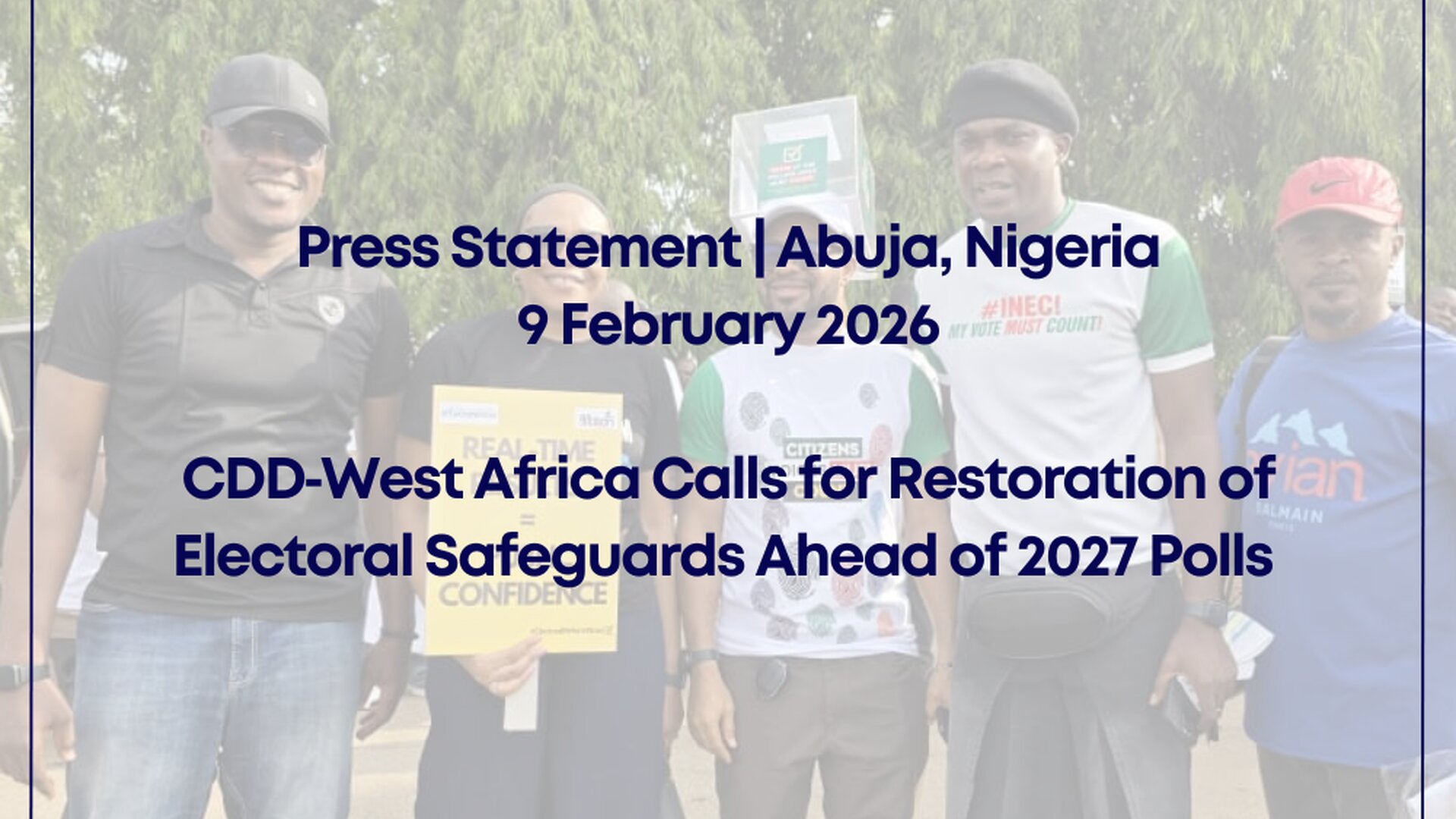
CDD‑West Africa Calls for Restoration of Electoral Safeguards Ahead of 2027 Polls
The Centre for Democracy and Development (CDD-West Africa) is deeply concerned by the Senate’s passage of a retrogressive version of the Electoral Act (Amendment) Bill 2026. Of particular concern is the rejection of the amendment to Clause 60(3), which would have made the electronic transmission of results from polling units to the INEC Result Viewing Portal (IReV) mandatory.
This amendment, widely endorsed by citizens and civil society alike, was one of the most critical innovations proposed to restore public confidence in Nigeria’s elections. Its removal will not only weaken transparency safeguards, it will also reopen the very loopholes that the reforms seek to close.
Worryingly, the Senate’s decision contradicts the position of the House of Representatives, which explicitly approved mandatory real-time transmission of results during its clause-by-clause consideration of the same bill. Rather than building on the painful lessons of the 2023 general elections, marked by technical failures and eroded trust, the contrary position by the Senate to the progressive stand of the House of Representatives signals a dangerous reversal of reform intended with the Bill.
Beyond the transmission clause, the Senate also voted to reduce the constitutional window within which INEC can issue the Notice of Election, from 360 days to 180 days before polling day. This change poses a severe logistical threat. The current timeline of 360 days was carefully calibrated to provide INEC with sufficient time to plan, procure sensitive materials, train election personnel, and conduct civic education. Compressing this window could trigger cascading challenges across the entire electoral calendar, destabilizing voter registration and collection of voter cards, inflaming party nomination disputes, and increasing the risk of pre-election litigation.
These amendments appear to depart substantially from the consensus reached by the Joint National Assembly Committees on Electoral Matters, who engaged in extensive consultations with electoral stakeholders, including CDD and the Nigeria Civil Society Situation Room. That the Senate ignored this input, despite a public protest held at the National Assembly by civil society actors on 28 January 2026, reflects an alarming disregard for civic engagement and stakeholder voices.
As Nigeria prepares for the 2027 general elections, we cannot afford half-measures or legislative backpedaling. The rejection of mandatory real-time result transmission and the shortening of INEC’s operational window constitute a direct threat to the credibility of our elections and the stability of our democracy.
CDD-West Africa thus calls on the National Assembly Conference Committee to restore the progressive provisions agreed by its Joint Committees, particularly mandatory electronic transmission of results and a realistic electoral timeline. The harmonization process must not be used to further dilute the integrity of the Bill.
Democracy is sustained by trust. And trust is earned through credible institutions, responsive lawmaking, and systems that protect the electoral will of the people. CDD-West Africa urges the leadership of the National Assembly to demonstrate statesmanship in this critical moment, and to deliver a reformed Electoral Act that truly serves the Nigerian people.
SIGNED
Dauda Garuba, PhD.
Director,
CDD-West Africa
For media enquiries or conference participation, please contact Faridha Salihu-Lukman, Communications Officer (fslukman@cddwestafrica.org or 0810 625 9235). Press statements are also available at www.cddwestafrica.org/press-releases, and other reports cited and referenced are available at www.cddwestafrica.org. CDD-West Africa is available on social media platforms with the handle CDDWestAfrica.